
Play is not a waste of time
What children learn when they play, from pre-school to primary school, and what parents can do (even in just 10 minutes a day).
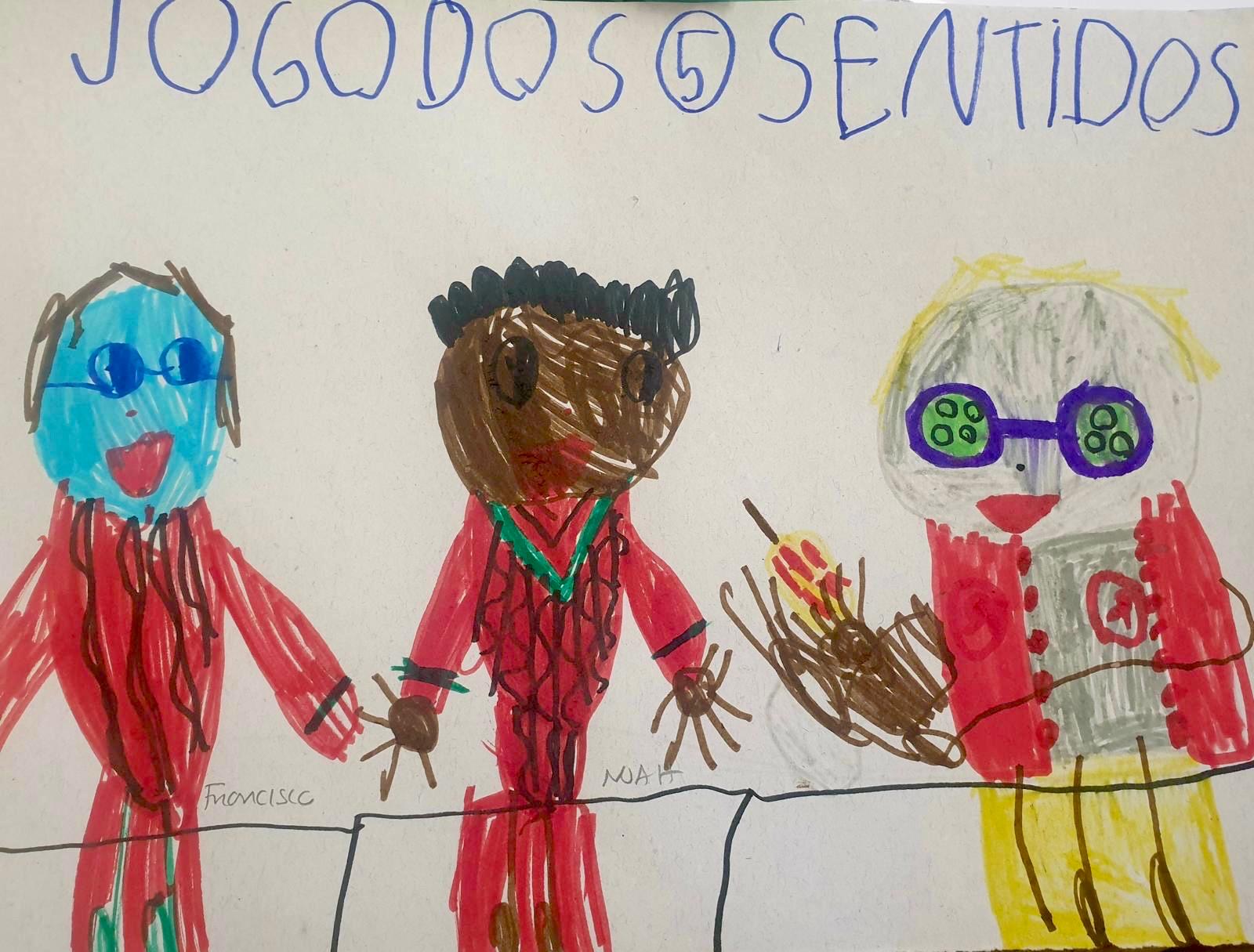
People still say: "They're just playing." Behind those words a common assumption: that play is what children do when they are not learning.
Research in child development points the other way. Through play, children build skills they will need at school and beyond.
Eduardo Sá's warning
In October, psychologist Eduardo Sá wrote in Observador that free time and play are becoming extinct. Children have little free time during the week and little time to play at weekends. Many parents count extracurricular activities as free time and do not see unscheduled time, time free of activities, as part of growing up.
Heavy routines and tired parents limit time for family play, and children rarely have time to play on their own. At school, play is generally confined to break time and is hardly ever used for learning. For Eduardo Sá, the room a school gives to play should be one of the measures of its quality.
At O Lar da Criança we share this view, which is why we create moments for learning through play and learning to play. At our school, play does not happen only between lessons.
What children learn through play
When they play, children test ideas, solve problems and expand their vocabulary. They learn to wait their turn, to share and to understand how others feel. Through play, children develop three key areas during the pre-school years: school readiness, social skills and emotional regulation. In primary school, play also supports independence, motivation to learn, and empathy.
In pre-school: instinct is not enough
Young children play spontaneously, but creative play does not sustain itself. Without an adult nearby who follows and joins in, it tends to become poorer. And when children play only among themselves, without guidance, more conflicts can arise; playing cooperatively is also something children learn. At home, good options include pretend play (such as pretending to cook and eat, make-believe phone calls or playing with dolls), building with blocks and repetitive activities, such as filling and emptying containers or reading the same story again.
In primary school: games with rules
After the age of 6, most children become interested in games with rules, winners and losers. Some become very rigid about the rules; others want to change them in their favour. Both reactions are normal (at this stage).
Many still lack the tools to cope with losing or to negotiate rules with classmates. Playing with an adult at home is good practice:
- Let your child explain the rules and play by them.
- Avoid too much competition and show how to win and lose gracefully.
- If your child wants to change the rules or stop, follow their lead. Learning to lose comes from many other situations.
Pretend play can also be valuable at these ages, particularly for sharing emotions and experiences. At this stage, play helps develop autonomy, the desire to learn and empathy, skills that grow throughout primary school.
The attention you give is what grows
Behaviour that receives attention tends to be repeated. When children can count on attention when they play well, they no longer need to seek it in other ways. Parents may notice that, by setting aside time to play every day, their children start playing on their own (also very important) for longer.
To end playtime smoothly and without tantrums, it helps to give a warning and set the next time: "Now it's dinner time. We'll play again tomorrow."
Five things parents can do
- Let your child lead. When the adult organises everything, the child ends up watching. If the child decides, a tractor piece can become a spaceship. Play is one of the few moments when a child can legitimately be in control.
- Describe instead of asking. Questions we already know the answer to ("What colour is this?") work like tests. Commenting on and describing what the child is doing does more for language: "You're putting the car in the garage."
- Praise specifics, don't correct. "You invented your own game" is worth more than "That's not how it's done". What matters is the process, not the result.
- Join in the pretend play. Puppets, dressing up or role play help children think symbolically and put themselves in someone else's shoes. It is also easier to talk about emotions (such as fear or sadness) through a character.
- Give your full attention, even if only briefly. Ten minutes without a phone are worth more than an hour of half-hearted attention. Children notice when your mind is elsewhere.
Sources: Carolyn Webster-Stratton, The Incredible Years (Portuguese edition: Anos Incríveis), chapter 1 · Eduardo Sá, "O tempo livre e o brincar estão em vias da extinção" (in Portuguese), Observador, 18 Oct. 2026
Come and see how we play and learn at O Lar da Criança.
Book a visit